Behold the Wondrous Evoluscope, a ground breaking mind bending parascientific device which allows us to take snapshots of the future. Future scenarios are projected through hpotheses of how our current civilisation could evolve. The evolution, mutation and hybridisation of the architectural type provides the final scope of our investigation which is seen as an expression of this change. This is the architectural thesis of Scott Mason at The University of Melbourne.
Showing posts with label Food. Show all posts

Sunday, May 9, 2010

Hydroponic Experiments - 50 000 people - Massing


50 000 people food supply with Flat Bed Hydroponic system.
  • 114 floors
  • 418m high building
  • 786411m2 worth of growing and floor area
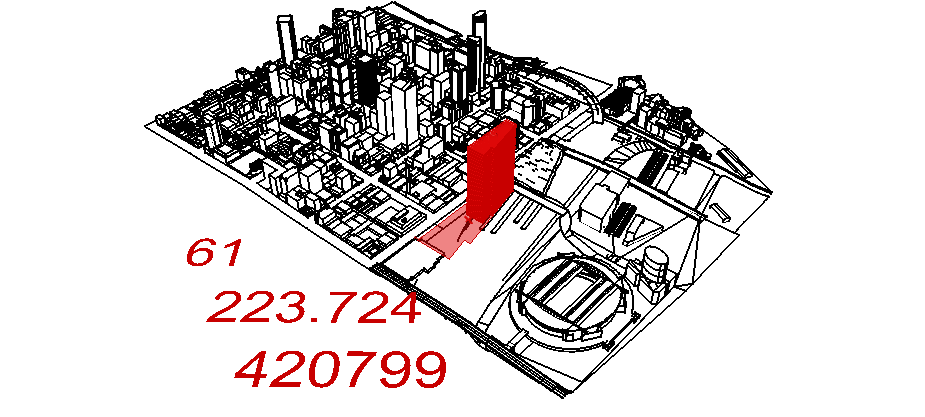


    50 000 people food supply with Stacked Hydroponic system.
    • 61 floors
    • 223m high building
    • 420799m2 worth of crop floor area
    • 1 258 500m2 worth of crop growing area

    Hydroponic Experiments - 50 000 people


    Food Supply


    Hydroponic Experiments - 100 000 people - Massing


    100 000 people food supply with Stacked Hydroponic system.
    • 120 floors
    • 440m high building
    • 2517000m2 worth of growing and floor area
    • 836100m2 worth of crop floor area


    100 000 people food supply with Flat Bed Hydroponic system.
    • 361 floors
    • 1324m high building
    • 25170004m2 worth of growing and floor area

    Hydroponic Experiments - 100 000 people


    Agrindustrial

    New agricultural landscape as peri urban land diminishes.


    Site Supply

    Based on ABS statistics the site required to supply 100 000 people is enormously large. The skyscraper would stretch up from the ground 78982.2m.  Untenable......


    Food Supply


    Melbourne's CBD poulation has grown rapidly since the inception of the Melbourne 2030 development plan.  An increase in residential supply is set to continue into the future.  The Spencer street site has the potential to deliver food to 100 000 people within a nominal 1km walking distance zone.


    What We Eat

    Agindustrial

    Australians Spend $100 dollars on groceries each year.  Out of all of Australias Land Mass only 10% is arable land of which, most is located on the peripery of urban areas, in areas such as Melbournes Green Wedges.  The developement of these Green Wedges continues against the recomendations of the Melbourne 2030 planning document.  As this   It is from here that most of Melbournes perishable vegetable supply is grown.

    Thursday, April 29, 2010

    the Vanishing Shopping Mall - Catalysts

    Armed with this arsenal of weapons to withdraw us from our money shopping in America and Australia and indeed all over the world has recently seen a marked decrease.  More Than  400 of the 2000 largest malls in America have closed over the past 2 years.  Some 150 000 retailers are projected to fail in America this year and so mall foreclosures will be imminent.  A mall or shopping centre represents discretionary spending and discretionary spending is in decline.  Retail sales figures here in Australia are following the same patterns in America and the world.  Retail expenditure here dropped significantly since the global financial crisis struck in 2009.  Consumers are spending less and spending less often.  As the over retailing of our urban environment continues those centres least able to offer consumer incentives through activity, form and environment are at risk.


    Sunday, April 18, 2010

    Hydro Crop Growing

    Victory Gardens

    During the second world war as men were overseas fighting the production of food in countries such as America, Canada and Australia experienced food shortages.  Governments adopted a media push urging housewives to grow their own vegetables as a means of supporting their dietary needs.  Through a localisation of the food supply shortages of food  were addressed. Called “Victory Gardens” the scheme worked very well until the return of the soldiers whereby food production returned to its pre war cycle.